Cold brew is coffee made with time instead of heat. Twelve hours of cold steeping pulls out the sweetness and the chocolate notes while leaving most of the acid behind, which is why cold brew tastes smooth even when the same beans run sharp as espresso.
The ratio here, about one part coffee to seven parts water by weight, makes a concentrate on purpose. Concentrate keeps better, takes ice without going thin, and lets everyone at the fridge mix to their own strength.
Why the acid stays behind

The compounds that read as sour and bitter in coffee extract fastest at high temperatures. At fridge temperature they mostly stay locked in the grounds while the sugars, chocolate, and nut flavors work their way out over the hours. The result measures about two-thirds the acidity of hot-brewed coffee from the same beans, which is why cold brew agrees with people whose stomachs argue with drip.
Heat is a shortcut with a cost. Water at 200 degrees F strips a coffee bed in about 4 minutes and drags the harsh compounds out with the good ones. Water at 40 degrees F needs half a day for a gentler version of the same job, and it never gets hot enough to break chlorogenic acids down into the bitter quinic acid you taste in a scorched pot. Slow is the whole mechanism.
The two ratios that matter
Everything about your batch flows from one decision: concentrate or ready-to-drink.
| Style | Ratio by weight | Coffee | Water | What it is for |
|---|---|---|---|---|
| Concentrate | 1:7 | 115 g (4 oz) | 800 g (27 oz) | Cutting one-to-one over ice; keeps all week in less fridge space |
| Ready to drink | 1:15 | 115 g (4 oz) | 1,725 g (58 oz) | Pouring straight from the bottle, no mixing |
The recipe above uses 115 g of coffee to 32 oz of water, which lands a shade looser than strict 1:7 but still firmly in concentrate territory. Measure by weight, not by scoops: coarse grounds pack a measuring cup inconsistently, and a 20 percent swing in dose is the difference between rich and thin. A coffee scale reads to the gram and settles the argument before it starts.
Immersion or slow drip
There are two ways to make cold brew, and they produce noticeably different glasses from the same beans.
Immersion is the simple one: grounds and water sit together for the full steep, then you strain. Full contact for 12 hours pulls a heavier body with more texture, and some fine sediment usually rides into the bottle. It tastes like it sounds: dense and round.
Slow drip, sometimes called Kyoto-style, drips cold water through a bed of grounds one bead at a time. Each drop passes through once and moves on, so the extraction is more even and the cup comes out cleaner, brighter, and more tea-like in clarity, with far less silt in the bottle.
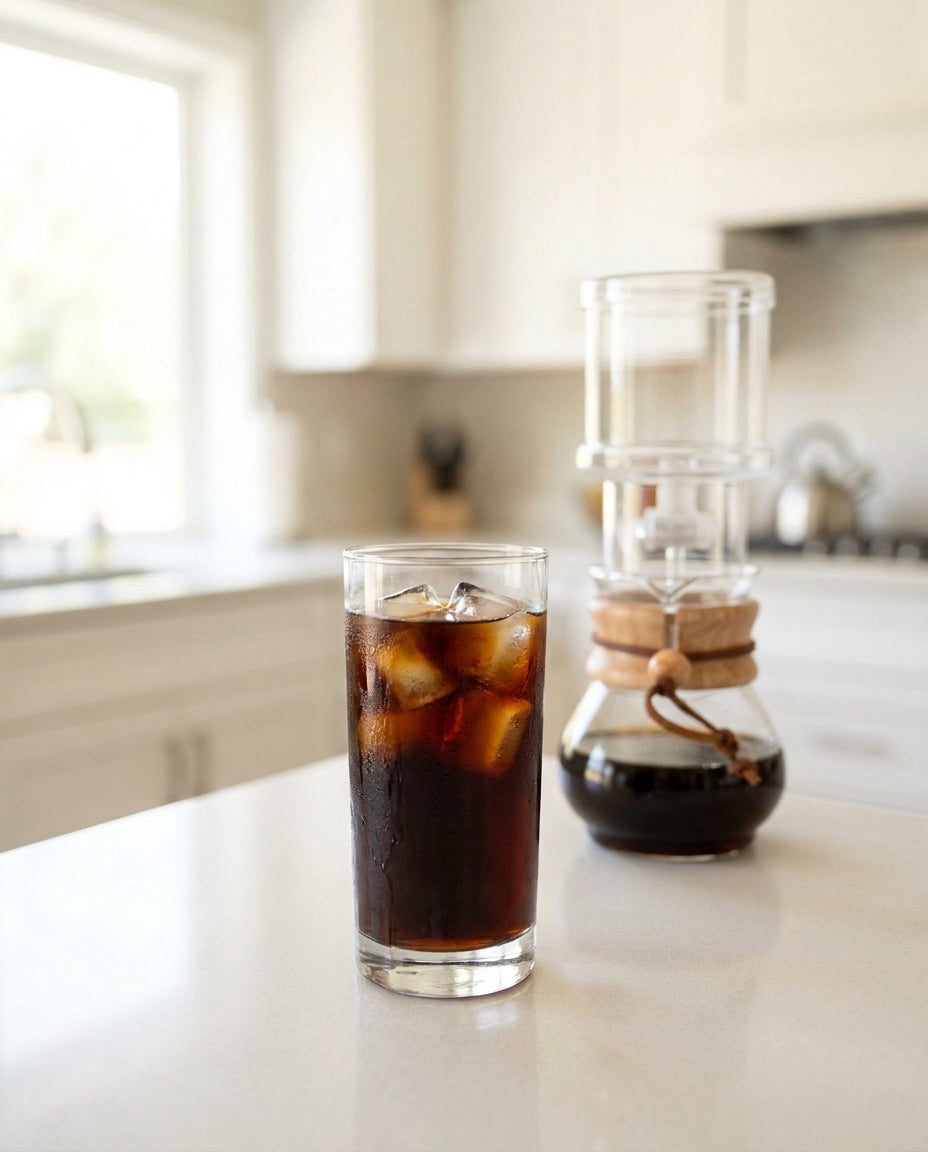
The glass kit in this recipe is a slow-drip brewer, which is why step 3 says to set the drip rate. Aim for roughly one drip per second and the 32 oz works through the bed over the long steep. Run it as a straight immersion batch instead and the same 12-hour clock applies; expect a slightly thicker cup.
What steep time actually does
Cold extraction follows a curve, not a straight line. Most of what the water will take from the grounds, it takes in the first 12 hours. After that the curve flattens hard, and what little still extracts is the woody, papery end of the flavor spectrum.
- 8 hours: drinkable but light. Brighter, thinner, less sweetness developed. Fine if you started late and need coffee by morning.
- 12 hours: the sweet spot. Sugars and chocolate notes fully developed, acids still mostly locked in the grounds.
- 18 to 24 hours: no meaningful gain in strength, real gain in bitterness. If 12 hours brews weak, the fix is more coffee, never more time.
Temperature sets the pace. Room temperature runs the chemistry faster; the fridge runs it slower and safer. A counter batch is fully there at 12 hours, while a fridge batch at the same mark tastes slightly lighter, so if you steep cold, take the full 12 and do not pull it early. The fridge's quiet advantage: the batch is already chilled and ready to pour the moment it finishes.
The water is most of the glass
A finished cup of coffee is more than 98 percent water, and in cold brew that water never gets boiled or driven off as steam. Whatever it tastes like going in, it tastes like coming out, concentrated by 12 hours of contact with the grounds.
Chlorinated tap water is the usual saboteur. In a hot brew, some chlorine flashes off with the heat; in a cold steep it sits in the vessel all night reacting with the coffee and reads as a flat, faintly medicinal edge in the finished bottle. A basic carbon filter pitcher removes it, and that is all the treatment the batch needs. Skip distilled water, though: extraction wants some mineral content to work against. If you would happily drink a glass of the water plain, it will brew well.
Choosing beans for the cold
Cold brew flatters some beans and wastes others. Medium and medium-dark roasts with chocolate, nut, and caramel tasting notes are the home ground: those flavors extract beautifully at low temperature and they are exactly what the 12-hour steep amplifies. A Brazilian single origin leans naturally nutty and sweet; a blend built around chocolate notes delivers the same profile with batch-to-batch consistency, which matters when you brew 32 oz at a time. Save bright, floral, light-roasted single origins for hot brewing: the delicate aromatics that make them special are the first thing the cold leaves behind.
Freshness rules relax here, and that is useful. For espresso, beans peak in the first 2 to 4 weeks after roasting. Cold brew is far more forgiving: beans 6 to 8 weeks off roast still make an excellent batch, because the fast-fading aromatics were never the point. One rule does not relax: grind right before you brew. Ground coffee stales in hours, whole beans in weeks, and a burr grinder set coarse gives the even particle size the steep depends on.
Four drinks from one bottle
A bottle of concentrate is a week of options. Cut one-to-one with cold water over ice for straight cold brew. Cut with milk instead and you're next door to an iced latte, no machine needed. Warm water turns it into a gentle approximation of an americano. And a splash of concentrate in the shaker deepens an espresso martini batch without pulling extra shots. Everything the batch needs - brewer, bottle, filters - lives in our cold brew collection.
Serving it through the year
The one-to-one cut over ice is the default: fill a glass with ice, pour 4 oz of concentrate, top with 4 oz of cold water, and stop there. Clear glass cups show off the deep mahogany color 12 slow hours buys. With dairy, whole milk cut one-to-one lands close to a bottled cafe drink; oat milk is the best of the alternatives, holding its texture where almond tends to separate into flecks.
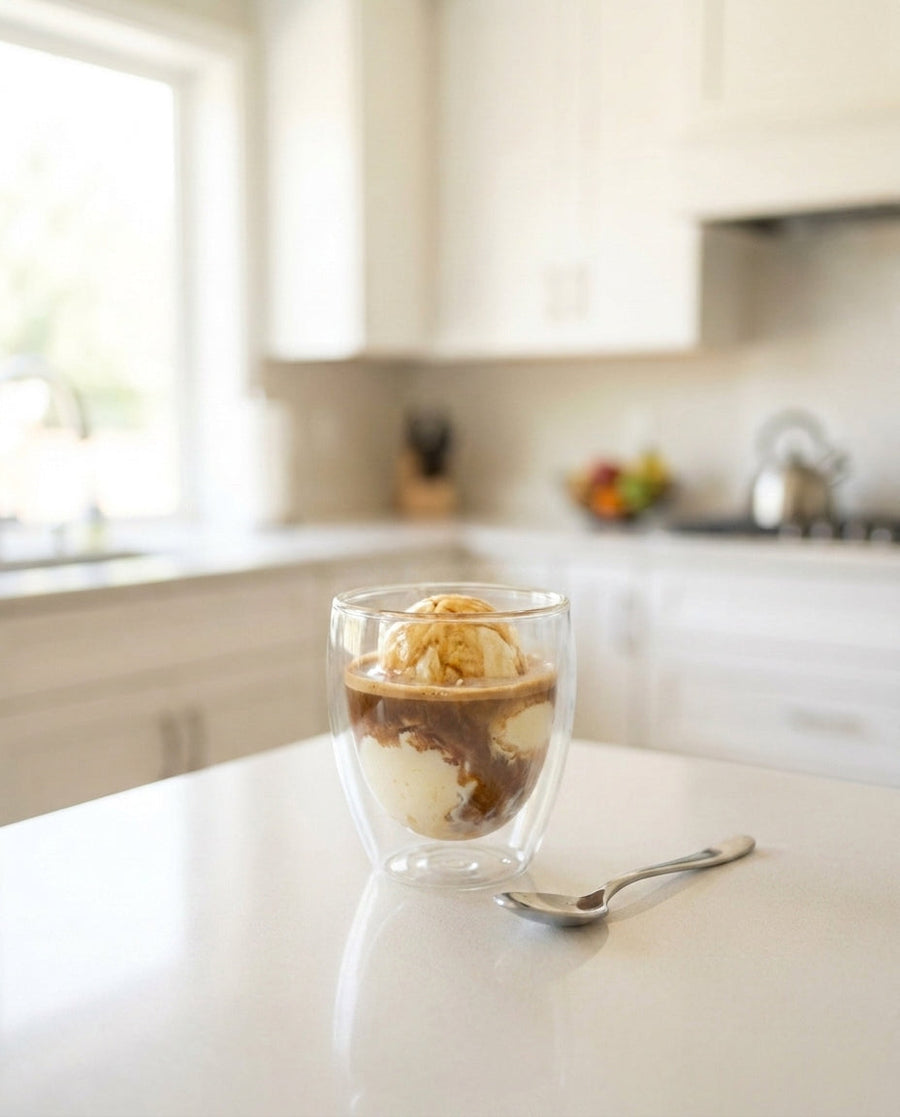
For dessert, pour 2 oz of concentrate over a scoop of vanilla ice cream and you have the cold-steeped cousin of an affogato. The concentrate is sweet and low in acid, so it needs no added sugar to sit against the ice cream.
And cold brew does not retire in winter. Mix concentrate one-to-one with hot water straight off the boil for a warm cup that keeps the low-acid smoothness. Heat the water, never the coffee: simmering the concentrate dulls the flavor you spent 12 hours building. A travel mug of the warm version is a fine commute.
And cold brew is not the light option. Iced coffee is hot-brewed drip poured over ice, diluted further as the ice melts. Cold brew cut one-to-one still lands around 100 to 150 mg of caffeine per 8 oz serving, similar to or higher than the iced coffee it replaces. It drinks gentler because the acid is low, not because the caffeine is.
Dial it in

Bitter or woody? You went too fine on the grind or too long on the steep. Coarser and shorter is the fix.
Weak? Do not steep longer, the extraction has mostly finished by hour 12. Use more coffee instead.
Cloudy or silty? The grind was uneven. A burr grinder holds a consistent coarse setting; blade grinders make dust alongside boulders, and the dust is what clouds the bottle.
The seven-day window
Strain the batch fully, bottle it, and seal it. Oxygen is the enemy of a finished brew, so a tight lid matters more than any other storage decision, and the back of the fridge beats the door shelf, where the temperature swings every time someone reaches for the milk.
Sealed and cold, concentrate holds for about 7 days. The flavor peaks in days 1 through 5; by day 6 or 7 the chocolate notes go flat and the cup tastes dull rather than bad. Store it as concentrate and dilute per glass: once water or milk goes into the bottle, a diluted batch fades in 2 to 3 days. Empty the 32 oz inside 5 days, which is 8 finished drinks, and you never meet the flat end of the window at all.
Worth knowing
A glass drip brewer is not just for looks. Watching the water work through the grounds is half the pleasure, and glass takes no flavors from batch to batch. Chocolate and nut roasts shine here, save the bright floral beans for hot brewing.