Pour over is coffee with nothing in the way. You pour hot water over a bed of grounds by hand, gravity pulls it through a paper filter, and what lands in the carafe is the clearest, brightest version of the bean you bought. The paper catches the oils and the fine particles, so the flavors come through sharp and separate: fruit tastes like fruit, chocolate like chocolate.
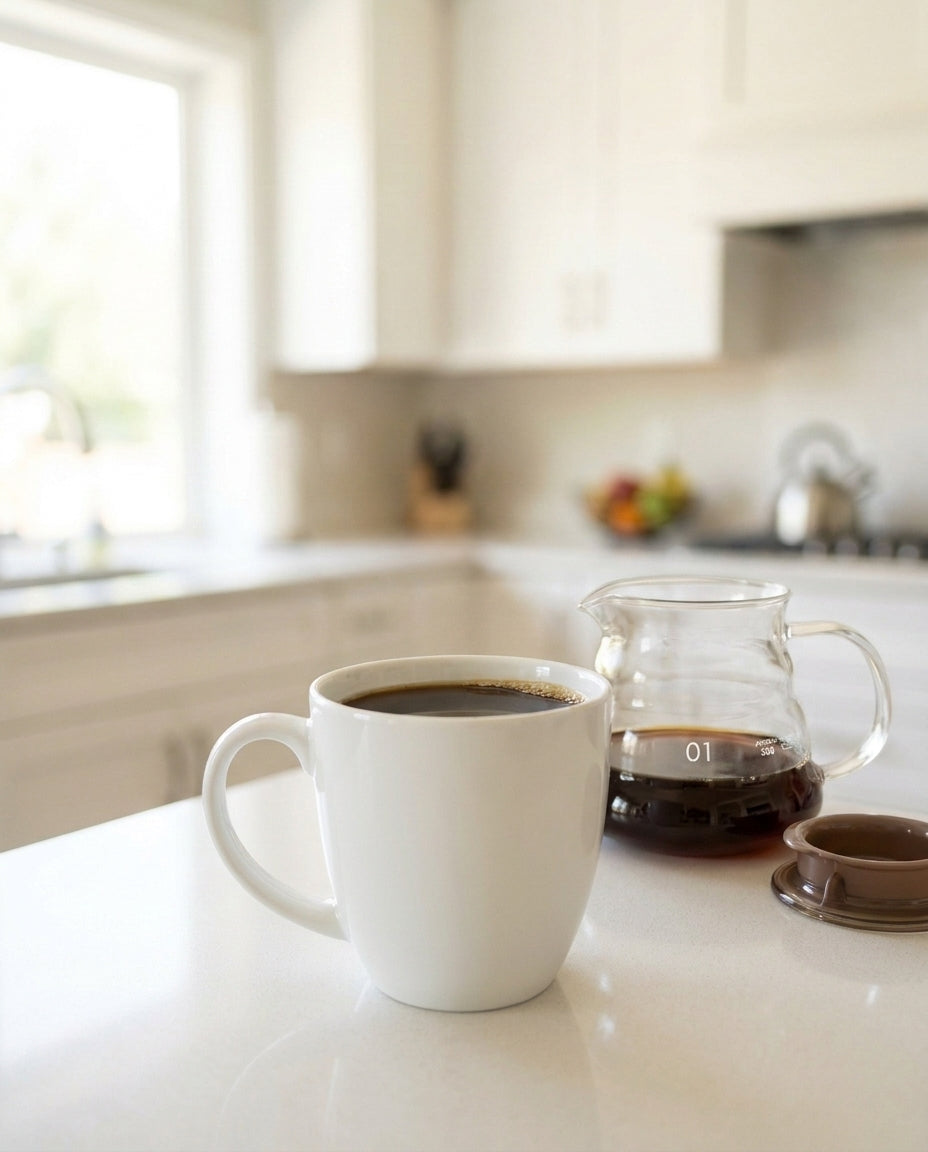
It takes three minutes and a little attention, and that's part of the appeal. Our Glass Pour Over Coffee Maker is a heat-resistant glass carafe with a cover, in 360, 600 or 800 ml, made to pair with a dripper and your choice of paper or reusable filter. This recipe makes one large mug or two small cups and fits every size.
Where the paper filter came from
Pour over owes its existence to a German homemaker. In 1908, Melitta Bentz of Dresden, tired of bitter, gritty coffee, punched holes in the bottom of a brass pot, lined it with blotting paper from her son's school notebook, and poured hot water through. She patented the idea the same year and started a company around it.
Hand-brewed filter coffee was the everyday method in much of Europe for decades, then gave way to automatic drip machines. It came back with the specialty coffee wave of the 2000s, when roasters started selling lighter, single-origin beans with flavors worth tasting clearly. A paper filter and a careful pour is still the most direct way to taste them.
The ratio, by carafe size
Our recipe runs at 1 part coffee to 16 parts water by weight. Go to 1:15 for a richer cup or 1:17 for a lighter, more tea-like one. The grounds hold back about twice their weight in water, so the carafe ends up with a little less than you poured.
| Carafe | Coffee | Water | In the carafe |
|---|---|---|---|
| 360 ml | 20 g | 320 g | about 280 ml |
| 600 ml | 32 g | 510 g | about 445 ml |
| 800 ml | 42 g | 670 g | about 585 ml |
Bigger batches take longer to drain, so expect the 800 ml brew to run closer to 4 to 4:30 minutes. Make sure your dripper holds the full dose and the water with room to spare.
Pour over is the brew where a scale earns its place on the counter. You're measuring the water as you pour, not only the beans, and the pour schedule in the steps is written in grams. Set the carafe and dripper on our coffee scale, zero it, and you get accurate measurements of both the coffee and the water as you brew.
Medium-fine, and why it matters
In a pour over, the grind sets the pace. The water runs through the bed under gravity alone, so particle size decides how fast it drains and how long it stays in contact with the coffee. Medium-fine, about the texture of table salt, gives a single mug a drawdown of around three minutes, which is the window where sweetness and acidity balance.
Go too fine and the bed chokes: water pools, the brew runs long, and the cup turns bitter and dry. Go too coarse and the water races through, leaving it sour and thin. Consistency matters as much as size, because the fine dust from an uneven grind is what clogs a paper filter. Our manual burr grinder gives a consistent grind, and grinding right before you brew keeps the aromatics in the cup.
Rinse the paper first
Pour hot water through the empty filter before the coffee goes in. It does two jobs: it washes out the papery taste a dry filter adds to the first few ounces, and it heats the dripper and carafe so the brew doesn't lose temperature on contact with cold glass. Seat the filter flat against the dripper walls, rinse, then tip the rinse water out of the carafe.
Our U-Shape Pour Over Paper Filters come 100 to a pack, in white or unbleached natural. Both brew well; give the natural filters a generous rinse, since unbleached paper carries more of its own flavor.
What the bloom is doing

Freshly roasted coffee is full of carbon dioxide from the roaster. When hot water first hits the grounds, that gas rushes out, the bed puffs up into a dome, and bubbles break on the surface. That's the bloom. If you pour your full volume straight away, the escaping gas pushes the water away from the coffee and the bed extracts unevenly.
So pour about twice the coffee's weight in water, 45 g for this recipe, wet every ground, and wait 45 seconds. Some brewers give the dripper a gentle swirl during the bloom to make sure there are no dry pockets. The fresher the beans, the bigger the bloom; coffee that barely puffs at all is past its best.
Pulse pours or one continuous pour
Once the bloom settles, there are two ways to add the rest of the water.
Pulse pouring adds it in stages, as in the steps above: pour to a target weight, let the level drop a little, pour again. Each pulse stirs the bed gently and keeps the water level steady, and the stages make it easy to hit the same timings every morning. It's the most forgiving way to start.
A continuous pour adds all the water in one slow, unbroken spiral, keeping the level in the dripper constant until you reach the target weight. It agitates the bed less and gives a very even, clean extraction, but it asks for a steady hand and a slow, controlled stream.
Either way, pour into the center and spiral outward to about a dime's width from the edge, then back in. Water poured down the paper walls runs around the coffee, not through it.
Reading the drawdown

The drawdown is the last stretch, when you've finished pouring and the water drains through the bed. For a single mug, aim for a total time between 3:00 and 3:30 from the first pour. A last gentle swirl after the final pour settles the grounds flat, so the water drains evenly through the whole bed.
Look at the bed when it's done. A flat, even bed means an even extraction. Grounds stuck high on the paper walls or a deep crater in the middle mean some water bypassed the coffee: pour more to the center and finish with that swirl next time.
Paper or metal filter
The filter decides the texture of the cup. Paper traps the coffee oils and fine particles, so the brew comes out clean, bright and clear, with crisp, separate flavors. A metal filter lets the oils and some fines through, and that gives a fuller, rounder body, closer to French press, with a little less clarity.
Neither is the wrong choice; they're two different cups. Our Glass Dripper & Carafe Set with Metal Filter brews with a reusable stainless steel filter, so there's no paper to buy, and it brews a full-bodied cup. It comes apart for easy cleaning and comes in 800 ml or 1000 ml. With a metal filter, grind a step coarser than you would for paper to keep fines out of the cup, and wash the filter after every brew so oils don't build up in the mesh.
Flat-bottom or cone dripper
Drippers come in two main shapes. A cone funnels the water to a single point, so it drains faster and responds more to how you pour. A flat-bottom dripper holds an even, level bed with the same depth all the way across, which gives a steady flow and a forgiving extraction, especially when you're starting out.
Match the filter to the shape. Our U-shape filters are designed for flat-bottom drippers, for even saturation and a steady flow rate, in three sizes: 7 x 13 cm, 9.5 x 16.5 cm and 12.3 x 19.2 cm. A cone dripper takes cone filters.
On the glass side of our range, the Glass Pour Over Filter Cup with Bamboo Tray has a ridged glass interior for even saturation and airflow, sits on a natural bamboo tray that catches drips, and comes in ruled or twill glass, 360 or 600 ml. It sits on the Glass Pour Over Coffee Maker for a complete brew-and-serve setup. For a statement coffee station, the Glass Pour Over Filter Cup is a glass cone in frosted red-to-gray glass on a black base with a flow lever, made to sit over the matching Glass Pour Over Coffee Server (600 ml).
The kettle
A gooseneck kettle is the one tool pour over fans swear by, and for good reason. Its long, narrow spout pours a thin, steady stream exactly where you aim it, which makes slow spirals and precise pulses easy. A kettle with a temperature setting takes the guesswork out of the 200 to 205 F target as well.
A regular kettle works with a little care. Pour slowly, from low over the dripper, and add the water in smaller pulses. Some brewers pour from the kettle into a jug with a narrow spout first, which gives the same control.
Water and beans
Brewed coffee is almost all water, and pour over hides nothing, so use filtered water you'd happily drink. Chlorine reads as a flat, chemical note; distilled water brews flat too, because extraction needs some minerals to work with.
This is the method for light and medium roasts and for single origins with fruit, floral or tea-like notes, the delicate flavors other methods blur. Buy beans with a roast date on the bag and brew them within about a month of roasting. Grind only what you need, right before you brew.
Dial it in
| Symptom | Likely cause | Fix |
|---|---|---|
| Drains in under 2:30, tastes sour or thin | Grind too coarse, or pouring too fast | Grind a step finer, pour slower in pulses |
| Runs past 4:00, tastes bitter or dry | Grind too fine, or too much agitation | Grind a step coarser, pour gently, swirl instead of stirring |
| Water pools and stalls near the end | Fine particles clogging the paper | Go coarser, use a burr grinder for an even grind |
| Grounds high on the walls, crater in the bed | Pouring on the paper, uneven flow | Pour to the center, finish with a gentle swirl |
| Papery taste | Filter not rinsed | Rinse with hot water before brewing; rinse natural filters well |
| Balanced but too strong or too weak | Ratio | Move between 1:15 and 1:17 |
Worth knowing
Pour over makes a good iced coffee in the same three minutes. Grind a step finer, brew with half the water hot over a carafe holding the other half as ice, and the coffee chills the moment it lands, with every bright note intact. For a slow, smooth glass with low acidity, cold brew takes the long route instead.
If you want more body and less fuss, the French press trades clarity for weight and needs no pouring technique at all. For espresso-strength coffee off the stove, there's the moka pot. And when you want to pull real espresso shots, that's the job of an espresso machine. For the clearest cup of a bean you love, though, pour over is where to start.