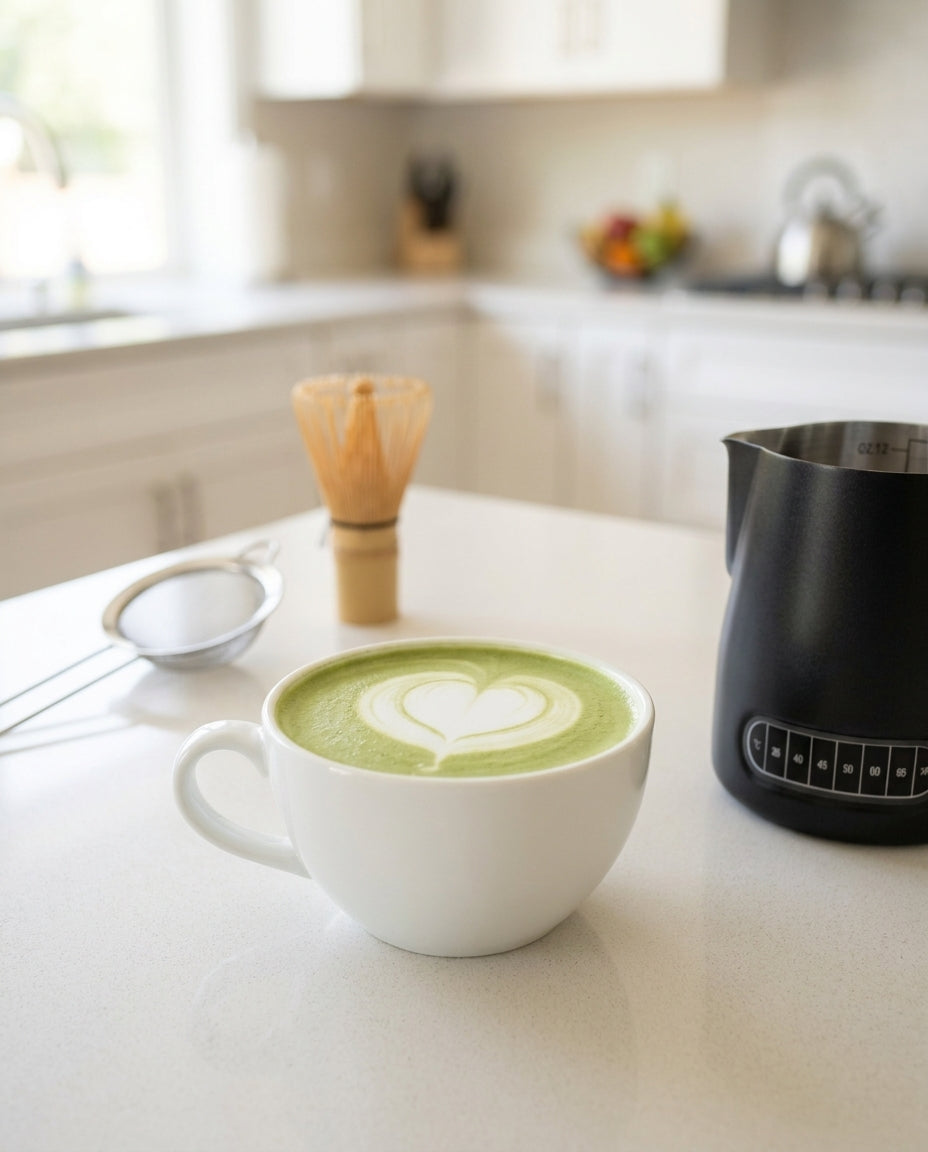
A matcha latte is built exactly like a coffee latte, with a whisked shot of matcha standing in for the espresso. Two ounces of bright green tea, 8 oz of steamed milk, a cap of foam. The result is creamy and mellow, with matcha's sweet, grassy flavor running through the milk instead of sitting on top of it.
Two steps make or break it: the shot and the milk. A matcha latte made by dumping powder into hot milk comes out lumpy and pale, with green specks clinging to the foam. A proper shot, sifted and whisked first, blends into the milk smoothly and keeps the color vivid from the first sip to the last.
Make the matcha shot first

Matcha powder doesn't dissolve; it disperses. Stir it straight into milk and the liquid wets the outside of each clump, sealing dry powder inside. Whisking it into a small amount of hot water first breaks every particle loose, and once it's a smooth, frothy shot it mixes into any amount of milk.
Sift the powder into the mug, add a splash of water, and work it into a paste with no dry spots. Then add the rest of the 2 oz and whisk in a fast W, back and forth across the bottom, for 15 to 20 seconds. Our 4-Piece Essential Matcha Preparation Kit covers this step with a 100-prong whisk, a stainless steel sifter, a scoop and a spoon, and it's built to work with the mug or bowl you already own. For the full technique, including the paste, the W and how the foam should look, our traditional matcha guide goes stroke by stroke.
Keep the water at 175 F. Boiling water pulls bitterness out of matcha, and milk softens bitterness but doesn't hide it. A wide mug gives the whisk room to move; in a narrow one, whisk the shot in a small bowl and pour it in.
How much matcha
The 2 g in this recipe gives a balanced latte: clearly matcha, still mellow. Cup size changes the answer, because milk grows with the cup and matcha only grows when you add more.
| Cup | Matcha | Water | Milk |
|---|---|---|---|
| 8 oz cup | 2 g (1 tsp) | 1.5 oz | 6 oz |
| 10 to 12 oz mug | 2 to 3 g | 2 oz | 8 oz |
| 16 oz mug | 4 to 6 g | 2 to 3 oz | 12 oz |
For the big mug, or any time you want matcha front and center, the 1 tbsp size of our Matcha Powder Measuring Spoon doses 6 g in one level scoop. The 1 tsp (2 g) size covers the everyday latte. Weighing the powder on a small coffee scale works too, and it's the fastest way to repeat a latte you liked.
Choosing matcha for milk
Milk is forgiving, so a latte doesn't need the top-shelf matcha you'd whisk with water alone. It does need matcha with enough flavor to come through 8 oz of milk. Everyday ceremonial grades and the culinary grades sold for lattes both work. What matters most is color: bright, vivid green powder makes a bright green latte with a clean, sweet flavor. Dull, olive-colored powder makes a khaki latte that tastes like hay. Our matcha guide explains how to read the grades.
The milk
Every milk works in a matcha latte, and each one changes the drink.
- Whole milk. The creamiest body and the most stable foam. Its fat rounds off matcha's bitter edge, and its natural sweetness grows as it warms.
- Oat milk. The classic plant-based pairing. Oat's gentle, cereal sweetness sits naturally with matcha's grassiness, so many people skip the sweetener. Look for a barista-style oat milk, which has the extra fat and protein to froth properly.
- Soy milk. The highest protein of the plant milks, so it builds firm, long-lasting foam. Its flavor is the most noticeable, so pair it with a bolder dose.
- Almond milk. The lightest option. It froths into bigger bubbles and its nutty flavor shows, so go up to 3 g of matcha.
- Coconut milk. Use the carton drinking kind, not canned. It brings a soft tropical sweetness that suits a vanilla or honey latte.
Reduced-fat dairy works with slightly thinner foam. Skim milk foams tall and airy but drinks thin.
Milk temperature

Stop dairy milk at 140 to 150 F. Milk tastes sweetest in that window, and the foam holds its structure. Past 160 F the proteins that hold the foam break down, a cooked flavor creeps in, and the sweetness fades. Plant milks are more delicate: stop oat, almond and soy at 130 to 140 F or they can separate and turn grainy.
Guessing temperature by touch is where most homemade lattes go wrong, which is why our Milk Frothing Pitcher with Thermometer has one built in. It shows you when the milk has reached frothing temperature without a clip-on probe to juggle. The pitcher is 304 stainless steel with a precision spout for pouring, in 350 ml or 600 ml, black or silver. The 600 ml size gives 8 oz of milk room to grow as it froths; the 350 ml suits a smaller 5 to 6 oz pour.
Three ways to froth
The goal is the same whichever way you go: warm milk with a fine, glossy foam and no big bubbles. Pick the method that matches your counter.
1. A handheld frother. Heat the milk first, in a saucepan or in a microwave-safe mug in 30-second bursts, then pour it into the pitcher. Lower the frother head into the milk before you switch it on, or it sprays. Hold the head near the surface with the pitcher tilted for the first 5 to 10 seconds to pull in air, then sink it halfway down for another 15 to 20 seconds to fold the bubbles into microfoam. Switch off before you lift it out. Our USB Rechargeable Milk Frother with Dual Whisk is built for this: a USB rechargeable motor, two whisk heads that texture milk into smooth microfoam, and a slim stainless steel body that lives in a drawer. No batteries to replace, and it handles cold foam for iced drinks too.
2. A steam wand. If you have an espresso machine, its steam wand heats and froths in one pass, and it gives you the silkiest microfoam of the three methods. Purge the wand, start with cold milk straight from the fridge, and hold the tip right under the surface for 2 to 3 seconds of hissing. Then sink it deeper and let the milk spin into a whirlpool until the pitcher's thermometer shows the milk is at frothing temperature, 140 to 150 F. The 10-Piece Espresso Machine Set has a built-in steam wand and a Thermoblock that's ready in 45 seconds, so a matcha latte takes no longer than a coffee one. Our latte recipe breaks steaming down phase by phase.
3. A saucepan. No frother, no machine. Warm the milk over medium-low heat, stirring, until steam rises and tiny bubbles form around the edge, about 3 to 4 minutes for 8 oz. Never let it boil. Then whisk hard with a balloon whisk, with the pan tilted so the milk pools deep, for 30 seconds until it turns frothy. Or pour it into the pitcher and finish it with the handheld frother, which builds a finer foam than hand whisking.
| Method | Foam | Time | Best for |
|---|---|---|---|
| Handheld frother | Light, smooth | About 2 minutes with heating | Any kitchen, hot or cold foam |
| Steam wand | Silky microfoam, pourable | About 1 minute | Latte art, making several drinks |
| Saucepan and whisk | Looser, airier | 4 to 5 minutes | No equipment at all |
Putting it together
Pour the milk into the matcha, not the other way around. Hold the pitcher 3 to 4 inches above the cup and pour in a thin, steady stream into the center, so the milk dives under the green shot and mixes with it. When the cup is two thirds full, drop the spout close to the surface and the foam spreads across the top.
Latte art works on matcha too. A frothy shot gives the white foam a green base to contrast against, and glossy, well-swirled milk has the texture to draw a heart or a simple tulip. Froth a little longer and you get a taller, spoonable cap instead. Either way it tastes the same.
Prefer to see the layers? Build it in a clear glass the other way up: steamed milk first, then pour the matcha shot slowly down the side. The green settles into a band between the milk and the foam. Our glass cups show it off.
Sweeteners
Matcha has a natural bitter edge, and a small amount of sweetener rounds it off without hiding the tea. Add it to the warm shot before the milk goes in: it dissolves instantly and the pour blends it through the drink.
- Honey. 1 to 2 teaspoons. Its floral sweetness is a classic match for matcha's grassy edge.
- Maple syrup. 1 to 2 teaspoons. Warm and toasty, and the best match for oat milk.
- Vanilla syrup. 0.5 oz, about 1 tablespoon. Gives you the cafe-style vanilla matcha latte.
- Sugar. 1 to 2 teaspoons, stirred into the hot shot until it disappears.
- Agave. 1 to 2 teaspoons. The most neutral of the liquid sweeteners.
Start at the low end. A fresh, bright green matcha needs far less sweetener than you'd expect, and with oat milk many people use none.
Flavor variations
Each of these builds on the base recipe. Add the flavoring to the shot unless it says otherwise.
- Vanilla. 0.5 oz vanilla syrup, or a quarter teaspoon of vanilla extract with a teaspoon of sugar.
- Honey cinnamon. 2 teaspoons of honey in the shot, a pinch of cinnamon dusted over the foam.
- Maple oat. Barista oat milk and 2 teaspoons of maple syrup. Our pick for a first matcha latte.
- White chocolate. Melt 1 tablespoon of white chocolate chips or sauce into the hot shot before the milk. Rich, sweet, and a favorite in winter.
- Lavender. 0.5 oz lavender syrup. Floral and soft, best with whole or oat milk.
- Chai spice. A quarter teaspoon of chai or pumpkin pie spice whisked into the shot with a teaspoon of honey.
- Dirty matcha. Pull a single shot of espresso and pour it slowly over the finished latte. The roasted coffee and the grassy matcha meet as you drink, and the darker espresso marbles through the green.
Prefer it cold? The same shot over ice and cold milk is our iced matcha latte, which also covers cold foam, strawberry and coconut versions.
Dial it in
If you see green specks in the foam or a sludge at the bottom, the shot wasn't fully mixed. Sift every time and whisk until the paste has no dry spots before adding the rest of the water.
If the latte tastes bitter, check the water first. Anything hotter than 180 F extracts bitterness, and so does an old or low-grade powder. A teaspoon of honey also rounds it off.
If it tastes weak or milky, raise the matcha before you cut the milk. Going from 2 g to 3 g makes a bigger difference than it sounds.
If the color is dull, the powder is old or low grade. Matcha fades once the tin is open, so keep it sealed and cold and use it within about a month.
If the foam collapses fast, the milk got too hot or had too much air. Stop at 150 F and keep the air phase to the first few seconds.
Caffeine and calories
A 2 g matcha latte carries roughly 40 to 80 mg of caffeine, depending on the leaf, which puts it in the same range as a single-shot coffee latte. The milk adds none. At 3 g it climbs accordingly.
With 8 oz of whole milk the latte comes to about 160 calories before sweetener. Barista oat milk lands around 120 to 140, unsweetened almond under 50, and each teaspoon of honey adds about 20.