Matcha is the one tea where you drink the leaf. Regular green tea is an infusion: hot water pulls flavor out of the leaves and the leaves go in the trash. Matcha is the whole leaf, stone-ground to a powder fine enough to whisk straight into water, which is why it tastes richer and greener than any tea bag and why the method matters so much more.
Three things decide the bowl: how much powder, how hot the water, and how you move the whisk. Get those right and the result is smooth and sweet with a gentle bitter edge, under a cap of foam so fine you can't see the individual bubbles. Get them wrong and you get a bitter, gritty cup that tastes like lawn clippings. Everything below is about the first version.
What matcha actually is
Matcha starts in the field. For around three weeks or more before harvest, growers shade the tea plants, which pushes the leaves to make more chlorophyll and hold on to more L-theanine, the amino acid behind tea's savory, brothy sweetness. That's where the vivid jade color and the umami come from. After picking, the leaves are steamed, dried and stripped of their stems and veins. That leaf, called tencha, is then ground between stone mills into matcha.
Powdered tea came to Japan from China, carried back by the Zen monk Eisai at the end of the 12th century, and the tea master Sen no Rikyu shaped the ceremony around it in the 16th. Most matcha still comes from a handful of Japanese regions, with Uji near Kyoto and Nishio in Aichi the best known. The ritual you're about to follow at home is the everyday core of that ceremony: warm the bowl, sift, whisk, drink.
The tools, and what each one does
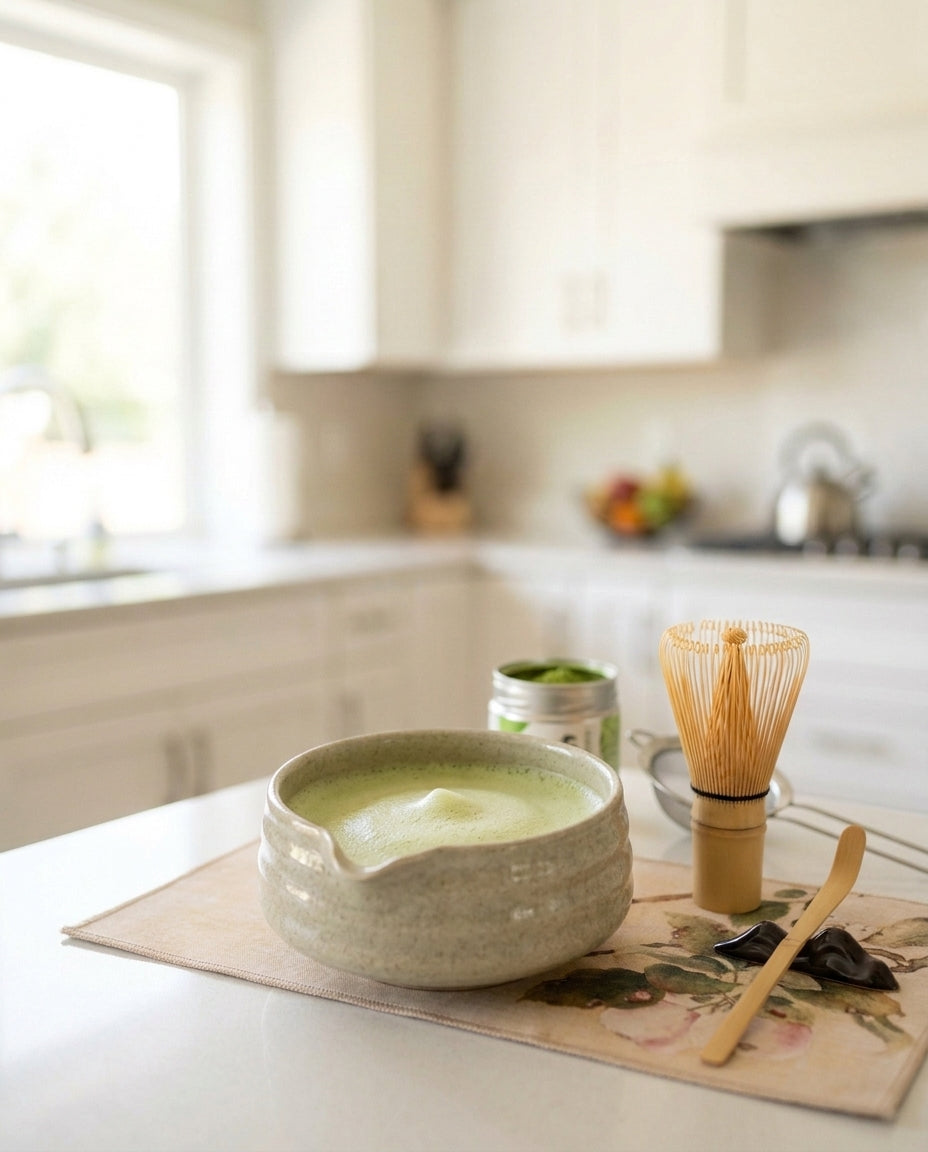
A traditional setup has five working parts, and each one solves a specific problem.
- The bowl (chawan). Wide and flat-bottomed, so the whisk has room to travel. A mug is too narrow for a proper W.
- The whisk (chasen). Dozens of fine tines cut air into the tea as tiny bubbles. A spoon or a fork stirs; a whisk foams.
- The scoop (chashaku) and spoon. For dosing and for pressing powder through the sifter.
- The sifter. Matcha clumps from static and humidity, and the sifter breaks those clumps before they reach the water.
- The whisk holder. A rounded stand the whisk dries on, tines down, so they hold their shape between uses.
Our 8-Piece Complete Matcha Ceremony Set puts all of it in one box: a whisking bowl with a pouring lip, a 100-prong whisk with its holder, a stainless steel sifter, a scoop, a spoon, a scoop-and-spoon rest and a mat. The rest keeps the scoop and spoon off the counter while you whisk, and the mat gives the whole ritual its own spot on the table. It's boxed and ready to give, which makes it the set we point to for anyone starting matcha from scratch.
Sift first, every time

Matcha particles are so fine they cling to each other, and any clump that reaches the water stays a clump. Whisking won't break it. You'll find it at the bottom of the bowl as a bitter, gritty pellet in your last sip.
Sifting takes 15 seconds. Hold the sifter over the dry bowl, add the powder, and press it through with the spoon or scoop in small circles. What lands in the bowl is a soft, even drift of green with nothing to catch on. If you only skip one step, don't let it be this one. It's the difference between a smooth bowl and a lumpy one, and no amount of whisking makes up for it.
Water temperature: the bitterness dial
Boiling water is the most common reason homemade matcha tastes harsh. Hot water extracts the tea's bitter, astringent compounds faster than it extracts the sweet, savory ones, so the hotter the water, the more the bitterness wins.
Aim for 160 to 180 F, with 175 F as the everyday target. The cooler end of the range brings out sweetness and umami in a high-grade matcha. The warmer end gives a brisker, more robust bowl and suits everyday grades. Without a thermometer, boil the kettle and let it stand with the lid open for about five minutes.
Water quality matters too, because a bowl of usucha is almost entirely water. Soft or filtered water tastes clean and lets the matcha's sweetness through. Hard, mineral-heavy water flattens the flavor and dulls the color.
The ratio
Usucha, the thin tea most people mean when they say matcha, is 2 g of powder in 2 to 2.5 oz of water. That's one level teaspoon, and the Matcha Powder Measuring Spoon makes it exact. It comes in 1/2 tsp (1 g), 1 tsp (2 g) and 1 tbsp (6 g) sizes, each marked on the handle, and the 1 tsp spoon is the standard bowl. If you're using a traditional scoop, two heaped scoops land close to the same dose.
| Style | Matcha | Water | Temperature | Motion | Finish |
|---|---|---|---|---|---|
| Usucha (thin tea) | 2 g (1 tsp) | 2 to 2.5 oz | 175 F | Fast W or M | Fine, even foam |
| Light usucha | 1 g (1/2 tsp) | 2 to 2.5 oz | 175 F | Fast W or M | Thinner foam, gentler flavor |
| Koicha (thick tea) | 4 g (2 tsp) | About 1 oz | 175 F | Slow kneading | No foam, glossy |
| Matcha latte | 2 to 3 g | 2 oz, then milk | 175 F | Fast W | Foamy shot under milk |
New to matcha and finding it strong? Start at 1 g. The flavor is gentler and the whisking works the same way. Move up to the full 2 g once the flavor feels familiar.
The whisk: W, not circles
Here's the thing about whisking matcha: stirring in circles doesn't work. A circular stir moves the tea around the bowl as one mass, so very little air gets in. A fast back-and-forth W or M shape, side to side across the bowl, makes the tines cut through the tea on every stroke, and that's what builds foam.
Hold the whisk upright by the handle, the way you'd hold a pen standing on end. The motion comes from your wrist, not your arm, and it's fast, as quick as you can keep it even. Keep the tines moving along the bottom without pressing them into it. Pressing down wears the tines and scratches the bowl, and it doesn't add foam. After 15 to 20 seconds the surface turns from dark and flat to pale and frothy.
Then finish properly. Slow the strokes, raise the whisk until the tines only touch the top layer, and make a few gentle passes to break any large bubbles into small ones. Lift the whisk straight out from the center and you leave a smooth surface with a soft rise in the middle.
Reading the foam

The foam tells you how the bowl went. A good bowl of usucha has an even layer of pale green foam made of bubbles so small the surface looks almost matte, like fine suede. Large bubbles that pop as you watch mean the strokes were too slow or too circular, or the whisk stayed too deep at the finish. Patches of bare dark tea mean the bowl needed a few more seconds.
Tea schools differ on how much foam they want. Some whisk to a full cap that covers the whole surface, others to a lighter layer with a crescent of tea showing. At home, aim for a fine, even foam that covers most of the bowl. That's the texture that makes usucha taste smooth and round instead of thin.
Usucha vs koicha
There are two traditional ways to prepare matcha. Usucha, thin tea, is everything above: 2 g of matcha whisked fast into 2 to 2.5 oz of water until it foams. It's the everyday bowl and what nearly every cafe serves.
Koicha, thick tea, doubles the powder and cuts the water to about 1 oz. It isn't whisked into foam at all. Instead you knead it slowly with the whisk, folding and turning the paste until it turns glossy and smooth with the body of thin paint. Koicha is reserved for the sweetest, highest grades, because at that concentration any bitterness has nowhere to hide. In a formal ceremony one bowl of koicha is shared between guests. If you want to try it at home, use your best matcha and go slowly.
Ceremonial vs culinary grade
"Ceremonial grade" is a label sellers use for their best drinking matcha, not an official standard, so judge the powder itself, not the word on the tin. Ceremonial matcha is made from young, tender leaves, usually from the first spring harvest, and it's meant to be drunk straight with water. Culinary grade comes from later harvests and older leaves, with a stronger, more astringent flavor built to hold up against milk, sugar and baking.
| Check | Ceremonial grade | Culinary grade |
|---|---|---|
| Color | Vivid jade green | Duller, olive or yellow-green |
| Texture | Silky, like talc | Slightly coarser |
| Aroma | Fresh, sweet, grassy | Muted, more vegetal |
| Taste straight | Sweet, savory, gentle bitterness | Sharp, bitter, astringent |
| Best for | Usucha, koicha, lattes | Lattes, smoothies, baking |
The color test is the one to trust. Bright green powder from Japan, with a harvest or packing date on the tin, is the safest buy. Brownish or dull powder tastes flat whatever the label says. For the bowl in this recipe, buy the best ceremonial grade you can. For milk drinks, an everyday grade does the job well, and our matcha latte recipe covers how to pick one.
Caring for the whisk
A bamboo whisk needs two minutes of care a day, and the most important step happens before you whisk. Dry bamboo is brittle. Standing the whisk in warm water for a minute softens the tines so they flex instead of snapping, which is why soaking comes first in the steps above. It also lets you check the tines are straight and none are tangled.
After the bowl, rinse the whisk in warm water by whisking it in the bowl a few times, with no soap. Bamboo is porous and soap leaves a taste behind. Gently straighten any bent tines, then stand it on its holder to dry, tines down. The holder lets air reach every tine and keeps the rounded shape that makes the foam, which is why it ships with the whisk in our ceremony set.
Keep the whisk out of the dishwasher and direct sun, and let it dry fully before you put it away. Our 100-Prong Bamboo Matcha Whisk comes in a storage tube, which is the place for it once it's completely dry or when you're traveling with it. Tines wear with daily use, and when they do, it's the replacement or upgrade for any set.
Storing the powder
Matcha fades faster than coffee. Light, heat, air and moisture all dull the color and flatten the flavor, and once a tin is open the clock runs fast. Keep it sealed tight, away from light, and use an open tin within about a month for the best flavor.
The fridge is the best place for an open tin, as long as it's airtight, because matcha picks up smells. Let it come to room temperature before you open it, or condensation forms inside and turns the powder into clumps. Unopened tins keep longer in the fridge or freezer.
Troubleshooting at a glance
Almost every bad bowl traces back to one of these.
| Symptom | Likely cause | Fix |
|---|---|---|
| Bitter, harsh taste | Water too hot, or too much powder | 175 F water, 2 g dose |
| Lumps or a gritty last sip | Skipped the sifter | Sift every time, press through with the spoon |
| Big bubbles that pop fast | Slow or circular strokes | Fast W from the wrist, finish at the surface |
| No foam at all | Whisk too slow, or water too cool | Brisker strokes, water at 160 F or above |
| Dull, olive color in the bowl | Old or low-grade powder | Fresh ceremonial grade, stored cold and sealed |
| Brittle or broken tines | Whisk used dry, or pressed into the bowl | Soak first, whisk lightly along the bottom |
Caffeine and how it drinks
A 2 g bowl of usucha carries roughly 40 to 80 mg of caffeine, depending on the leaf, which is usually less than an 8 oz mug of drip coffee and in the same range as a single-shot espresso drink. It drinks smaller than it is, too. Two ounces goes in a few sips, so the caffeine arrives in one short, warm bowl instead of a long mug.
The traditional way to drink it is with two hands around the bowl, in three or four sips, finishing with a short slurp that pulls in the last of the foam. In a formal ceremony the guest turns the bowl so its front faces away before drinking. At home, the only rule is to drink it while the foam is fresh.
From the bowl to the mug
Once you can whisk a good bowl, every other matcha drink is that same bowl with something added. Pour steamed milk over it and you have a hot matcha latte. Pour it over ice and cold milk and you have an iced matcha latte. The whisking bowl's pouring lip is built for exactly that move, so the shot goes into a glass or mug without running down the side. And if you drink coffee too, the milk technique carries straight over from our latte recipe.