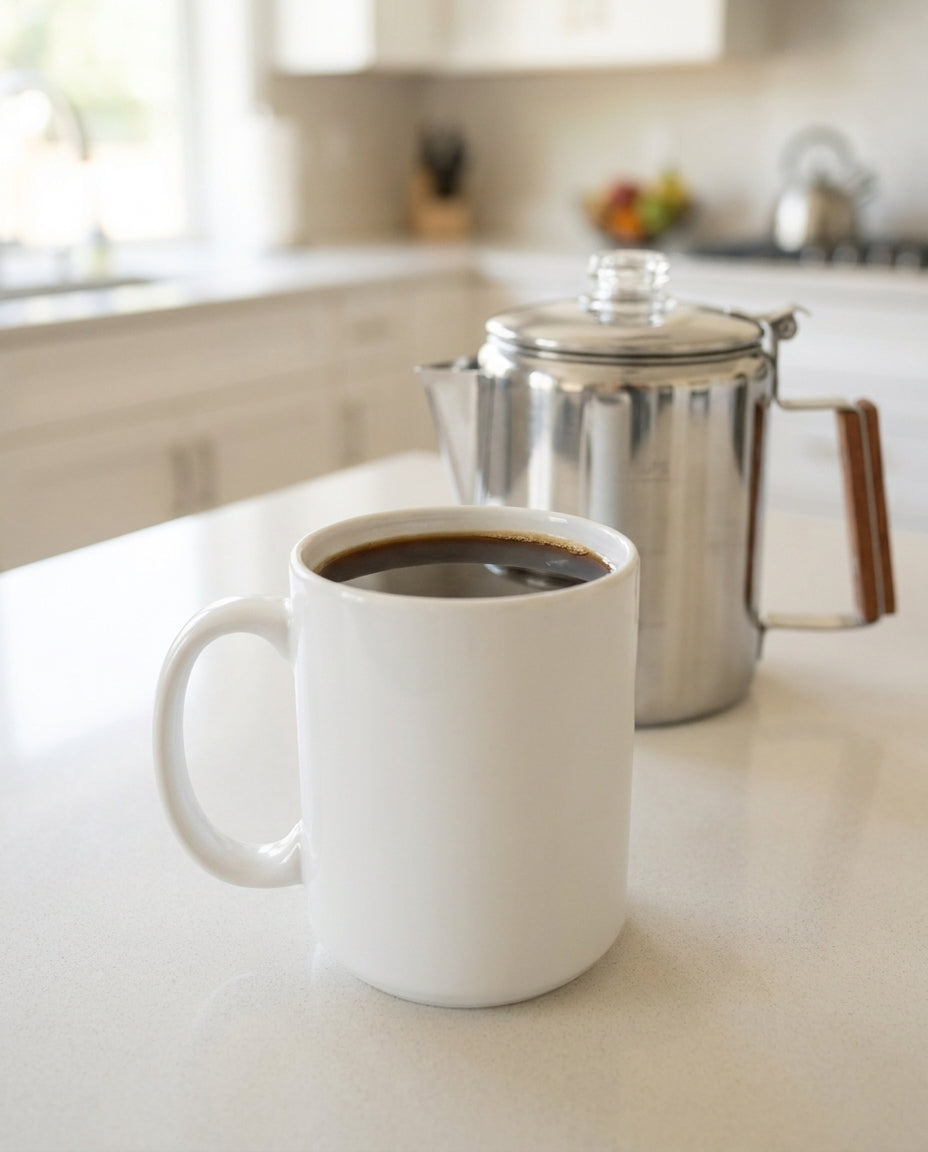
The percolator is the pot behind a lot of American mornings: on the range at your grandparents' house, on the camp stove at the lake, on the long table at church breakfasts. It brews a full pot of bold, piping-hot coffee with no paper filter and no power cord, and it gives you a show while it does it.
Our Stainless Steel Stovetop Percolator is built from 304 stainless steel and comes in 6, 9 and 12-cup sizes, from a quick morning pot to a full brew for guests. The glass knob on the lid lets you watch it perk, which, as you'll see below, is how you control the whole brew.
How a percolator actually works
A percolator is a loop. Water sits in the base of the pot and the coffee sits above it in a basket. As the pot heats, the water at the bottom of the central tube reaches a boil first, and the rising steam bubbles lift small slugs of water up the tube, the same way a bubble carries a drop of liquid up a straw. The water spills out over the basket cover, trickles down through the grounds, and drips back into the pot.
Here is the part that matters: after the first few minutes, what goes up the tube is not water any more, it's coffee. Every cycle runs brewed coffee back over the same grounds. That is why the color in the glass knob keeps darkening, why percolator coffee comes out bold and full-bodied, and why heat and time are the two variables you have to manage. Too hot or too long and the loop keeps pulling bitterness out of grounds that have already given their best.
Percolator, moka pot or drip?
All three are hot-water methods, but they treat the grounds differently. A drip brewer sends fresh water through the coffee once. A moka pot uses steam pressure to push the water through a tight bed of grounds once, into a sealed upper chamber, for small cups of concentrated coffee. A percolator works at normal pressure and passes the brew over a coarse bed again and again, for a big pot of strong, hot coffee meant for mugs.
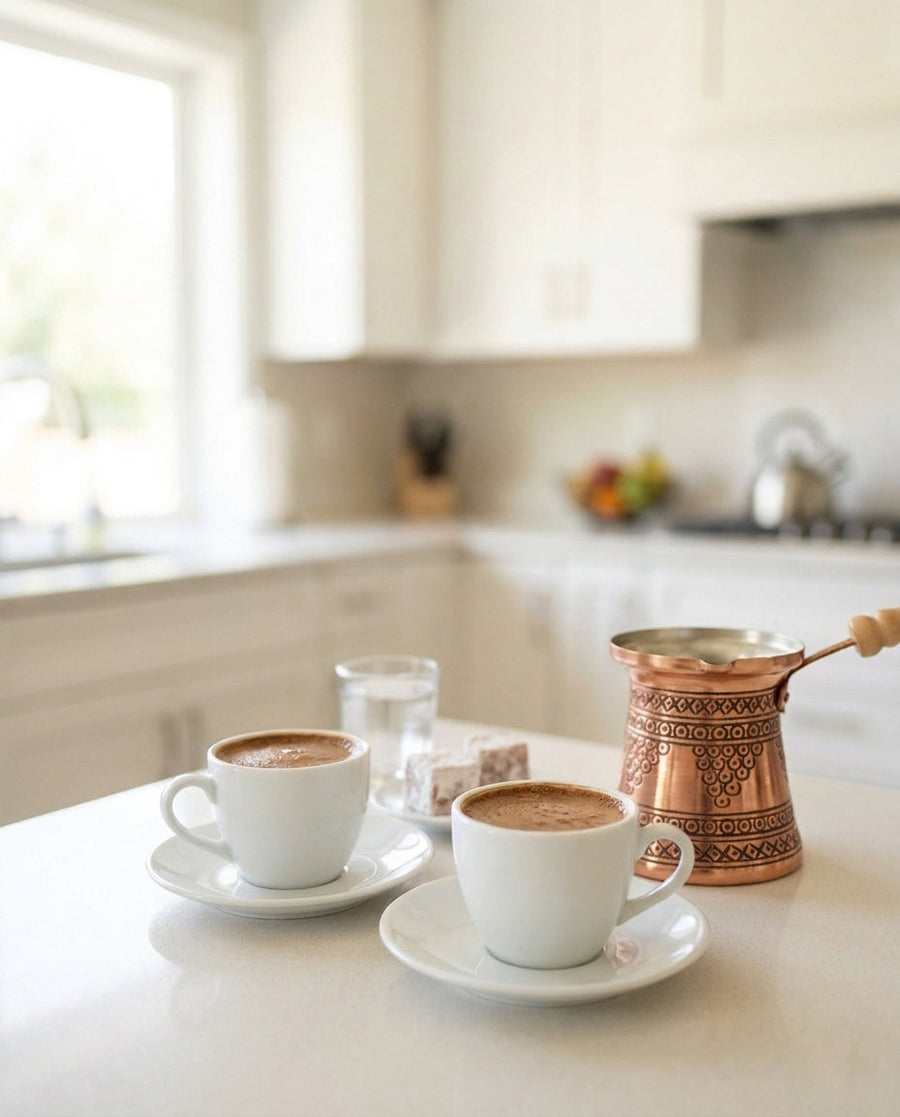
That makes the percolator the one to reach for when you're pouring for a crowd. If you want something small and intense instead, a moka pot or a cezve of Turkish coffee fills tiny cups.
Coarse grind, and why it matters here

Grind coarse, about the texture of kosher salt or coarse breadcrumbs, the same as you'd use in a French press. A percolator basket holds the grounds without a paper filter, so anything fine slips through into the pot and turns the cup muddy. Fine grounds also extract fast, and in a pot that recirculates coffee for 7 to 10 minutes, fast extraction tips straight into bitterness.
Grind right before you brew. Coffee loses aroma within hours of grinding, and a percolator, which leans hard on the coffee for flavor, rewards fresh grounds. Our Manual Coffee Burr Grinder gives you a consistent grind, and an even grind is what keeps a coarse bed from shedding dust into the pot. Pre-ground coffee from the grocery store is usually ground for drip machines, which runs too fine for a percolator.
How much coffee per cup
Start at about 14 g of coffee, 2 rounded tablespoons, for every 8 oz of water. That lands near the classic ratio of one part coffee to 17 parts water. Measure the water with a measuring cup and the ratio holds in any size of pot, from a quick 6-cup brew to a full 12.
Adjust strength with the dose, not the clock. If the pot tastes weak at 8 minutes of perking, add another tablespoon next time. Stretching the brew to 15 minutes doesn't make it stronger in a good way, it makes it bitter.
Read the glass knob
The glass knob on the lid is your dashboard. For the first few minutes on the heat nothing happens. Then the first splash of pale liquid jumps into the knob, and that is the moment to turn the heat down and start your timer.
Over the next 7 to 10 minutes, watch the color climb from pale gold through amber to deep chestnut. Chestnut is done for a medium-strength pot. If it heads toward black before your timer is up, the heat is too high; if it stays pale and the perks are slow and sparse, nudge the heat up a touch.
Gentle perk, never a rolling boil
The perk you want is a steady, unhurried pulse, a splash into the knob every two or three seconds. A frantic, continuous churn means the whole pot is at a rolling boil. At that point the coffee is cycling at full boiling temperature, the aromatics are steaming out of the lid, and the grounds are being over-extracted with every pass. Steam escaping from the lid is the same warning.
Medium heat to get it going, then low to medium-low to hold the pace, is the rhythm on most stovetops. On gas, keep the flame under the base of the pot, not licking up the sides. Electric coils and glass tops hold heat longer, so turn them down a little earlier.
Pull the basket when the time is up

The step most people skip: lift the basket out the moment you take the pot off the heat. Leave it in and the grounds keep dripping and steaming into the coffee below, which pulls bitterness into an otherwise good pot. The basket is hot, so use a towel or an oven mitt, and set it on a plate.
Then give the pot a minute to stand. Any fines that made it through settle to the bottom, and your last cup pours as clean as your first. If you won't drink the whole pot straight away, pour the rest into a thermal carafe or a travel mug rather than leaving it on a hot burner, which cooks it flat.
Beans that suit the pot
Medium and medium-dark roasts are the sweet spot. A percolator's long, hot brew draws out body and the deep notes: chocolate, nut, caramel, toasted grain. Very dark roasts already carry a lot of roast bitterness, and the recirculating brew stacks more on top. Bright, light roasts lose their delicate fruit notes to the heat.
Look for a medium roast from Brazil, Colombia or Sumatra if you want a classic, smooth percolator pot.
Coffee at the campsite
No cord, no filters, a 304 stainless steel pot: the percolator is made for camp mornings. Pack your coffee ground coarse at home, or bring whole beans and a hand grinder, and brew on a camp stove exactly as you would at home. Pick the size for your group: the 6-cup for a couple, the 12-cup when the whole site wants a mug.
Two campsite adjustments. Wind steals heat, so shield the burner and expect the first perk to take longer. And at altitude water boils at a lower temperature, around 203 F at 5,000 feet, so a pot brewed up high extracts more gently. Add a minute or two to the perk, or a little more coffee.
The pot from 1889
Hanson Goodrich, an Illinois farmer, patented the American stovetop percolator in 1889, and the layout he described is still the one in use today: water in the base, a tube up the middle, a basket of grounds hanging above. Percolators were the standard American coffee maker for much of the 20th century, stovetop first and then electric, until automatic drip machines took over the counter in the 1970s.
The stovetop version never went away, because it does something a drip machine can't. It makes a big pot of hot coffee anywhere there's a flame.
Troubleshooting at a glance
| Symptom | Likely cause | Fix |
|---|---|---|
| Bitter, harsh pot | Rolling boil, perked too long, or basket left in | Gentle perk, 7 to 10 minutes, lift the basket out straight away |
| Weak, watery coffee | Too little coffee, or grind too coarse | About 14 g per 8 oz; grind like kosher salt, not gravel |
| Grounds or sludge in the cup | Grind too fine, or basket overfilled | Grind coarser, level the basket, or add a filter paper |
| Won't start perking | Heat too low, or basket not seated | Medium heat to start, check the basket sits level and the lid is closed |
| Spitting or boiling over | Heat too high, or water above the basket | Turn it down at the first perk, keep the water below the basket |
| Burnt or stale taste | Old coffee oils in the pot, or pot left on the burner | Wash every part after each use, decant into a thermal carafe |
Cleaning
Stainless steel makes cleanup easy. After every brew, knock the spent grounds out of the basket into the trash or compost, then wash the pot, basket and cover in hot, soapy water. Unlike an aluminum moka pot, stainless steel doesn't need a seasoning layer, so dish soap is welcome. Run a narrow bottle brush through the central tube, where coffee oils collect, and rinse well.
Old oils are what give a neglected percolator a stale, rancid edge, so don't skip the wash. Once a month, or whenever you see mineral spots, fill the pot with equal parts water and white vinegar, perk it for a few minutes, then perk a round of plain water to rinse. Dry every part fully before you put it away.