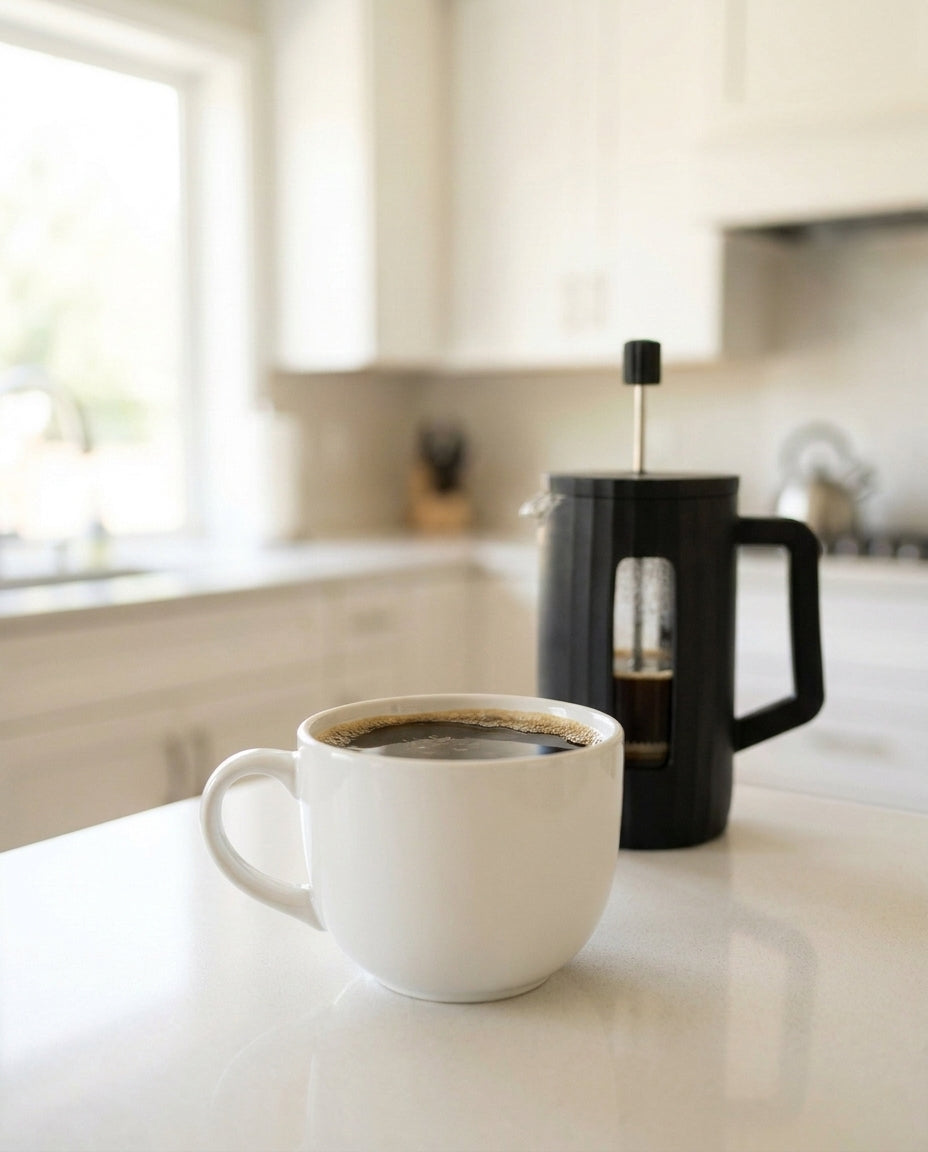
The French press is the simplest way to make a full pot of coffee by hand. Grounds and water sit together for four minutes, a mesh screen holds the grounds back, and you pour. No paper, no power, no technique to learn beyond patience.
What you get for that simplicity is body. The mesh lets the coffee's natural oils through to the cup, so French press coffee drinks rich, round and heavy in a way filtered coffee doesn't. Our Borosilicate Glass French Press in 600 ml brews this recipe with room to spare for the crust, and the 1000 ml size covers the whole table.
Why the press tastes the way it does
Two things set French press coffee apart. First, it's a full immersion brew: every ground spends the entire steep in contact with the water, so extraction is even and predictable, and the result depends on your ratio, grind and time, not on your pouring hand. Second, the filter is metal mesh, not paper. Paper traps the oils and the finest particles; mesh lets the oils through and holds back the grounds. Those oils carry aroma and give the cup its velvety, almost syrupy weight.
That's the whole character of the brew: deep, full-bodied and forgiving. Medium and dark roasts with chocolate, nut and caramel notes are the home ground here, because body is where those flavors live.
A short history of the plunger pot
The idea is French. Two Frenchmen, Mayer and Delforge, patented an early plunger-and-filter coffee maker in 1852: a filter on a rod, pushed down through a pot of grounds.
The press as you know it came from Italy. Designers Attilio Calimani and Giulio Moneta patented the modern form in 1929, and refinements through the following decades settled it into the glass carafe and mesh plunger on counters today. It goes by many names, cafetière in Britain, plunger in Australia, press pot in the US, and it stays on kitchen counters for the same reason it did then: it makes good coffee with nothing but hot water.
The ratio, by press size
Our recipe runs at 1 part coffee to 16 parts water by weight, the middle of the range most brewers settle on. Go to 1:15 for a bolder cup or 1:17 for a lighter one. The table scales it to the presses in our range, leaving headroom at the top for the crust.
| Press | Coffee | Water | What it makes |
|---|---|---|---|
| 600 ml glass | 30 g | 480 g (16 oz) | 2 cups |
| 750 ml stainless steel | 36 g | 580 g (20 oz) | 2 to 3 cups |
| 800 ml steel and glass | 40 g | 640 g (22 oz) | 3 cups |
| 1000 ml glass or stainless steel | 50 g | 800 g (27 oz) | 4 cups |
Weigh it. A tablespoon of coarse grounds holds about 5 g, but coarse coffee packs unevenly, so scoops drift from batch to batch. Our coffee scale gives you accurate measurements of both the beans and the water, and the same pot tastes the same every morning.
Grind coarse, and grind even

The French press wants a coarse grind, about the texture of coarse sea salt or fresh breadcrumbs. Coarse particles give the water four minutes of steady work without stripping the bitter compounds, and they're too big to slip through the mesh.
Evenness matters as much as size. A blade grinder smashes beans into a mix of boulders and dust: the boulders under-extract and taste sour, the dust over-extracts, turns the cup bitter, and clouds it with silt. A burr grinder crushes the beans between two burrs to a set size. Our manual burr grinder gives a consistent grind, and grinding right before you brew keeps the aromatics in the cup, not in the air of your kitchen.
If the plunger fights you on the way down, the grind is too fine. Go a step coarser next time.
The water: off the boil
Aim for around 200 F, which is a kettle off the boil and rested for 30 seconds. Hotter than about 205 F starts pulling harsh flavors from the grounds; cooler than about 195 F leaves the cup flat and sour. With a dark roast, let the kettle rest a full minute, since darker beans extract faster and taste better a few degrees lower.
Warming the press first is worth the ten seconds. A cold glass carafe drops the brew temperature the moment the water goes in. The borosilicate glass on our press takes boiling water, so a quick swirl straight from the kettle is all it needs.
Use water you'd happily drink. Filtered tap water is ideal; chlorine shows up in the cup as a flat, chemical edge.
The four-minute steep
When the water hits fresh grounds, they release carbon dioxide trapped during roasting, and the gas floats them to the top as a thick crust. That's the French press version of the bloom. Pour the full 480 g in one confident stream so the grounds tumble and wet through. If you see dry clumps riding on top, give the surface one gentle push down with a spoon.
Some brewers like a separate bloom: pour about 60 g of water, wait 30 seconds while the gas escapes, then add the rest. It's a small step that helps very fresh beans, which carry the most gas.
Then four minutes. Most of the extraction happens inside that window, and four minutes is the point where a coarse grind gives you sweetness and body without bitterness. Under three minutes tastes thin and sour; past six, the cup starts drying out.
The crust, the skim and the settle

Here's the move that makes French press coffee taste clean. At 4:00, stir the crust gently with a spoon, and the wet grounds drop to the bottom. A wooden or silicone spoon is kind to the glass. What's left floating is a layer of foam and the lightest particles: skim it off with two spoons and tip it into a spare cup.
Now wait. Once the grounds sink, they sit in a compact bed at the bottom and extraction slows to a crawl, so the extra minutes mostly let the fine particles settle out of the liquid. One minute gives a good cup. Five gives a noticeably cleaner, brighter one with very little silt.
If you're short on time, the classic route works too: press at 4:00 and pour. You'll trade some clarity for a faster cup.
Press gently
Lower the plunger slowly and evenly, about 20 seconds from top to the surface of the coffee. A fast push churns the settled grounds back up and forces fines through the mesh, which is where gritty French press coffee comes from. Pushing hard against resistance can also spurt hot coffee out of the spout.
If you've done the settle, the plunger has very little to do. It only needs to sit below the surface to keep the grounds in the press while you pour, so stop there and leave the bed undisturbed.
Decant, don't hold
Coffee left in the press keeps extracting from the grounds at the bottom. Within 15 to 20 minutes a sweet pot turns bitter and flat. Pour it all out as soon as it's pressed, into cups or a server, and brew a fresh press for the second round.
If you like a pot that lasts the morning, our Stainless Steel French Press holds heat well, in 750 ml or 1000 ml with a mirror finish. Same rule applies: press, then decant into a warmed carafe or thermal mug. For a pot you can watch steep and pour straight at the table, the Stainless Steel & Glass French Press sets a borosilicate glass body inside a stainless steel frame, at 800 ml.
Living with sediment
A little fine silt is part of the press's character. It comes with the oils and the body, and the steps above keep it to a minimum: a coarse, even grind, the skim, a few minutes of settling, a gentle press, and a careful pour.
Two habits take care of the rest. Leave the last half inch of coffee in the press, where whatever settled lives. And leave the last sip in your cup. If you want a cup with zero silt and a lighter, brighter body, that's the job of pour over coffee, where a paper filter catches everything.
Cleaning the press
Don't pour the grounds down the sink; they pack into the drain trap. Add a little water, swirl, and tip the slurry into a fine strainer or the compost, or scoop the bed out with a silicone spatula. Used grounds are good in the garden compost.
Rinse the carafe and the mesh under hot running water after every brew. Borosilicate glass won't hold onto old flavors, so a rinse leaves it clean. The oils build up on the mesh, though, and old coffee oil turns rancid and bitter. Once a week, take the plunger apart and wash the mesh screens and the carafe by hand in warm, soapy water, then rinse well and let everything dry before you put it back together.
Cold brew in a French press
The press makes a first-rate cold brew, because cold brew is an immersion brew too. Grind coarse, then combine about 1 part coffee to 7 parts cold, filtered water: 100 g to 700 g in a 1000 ml press, or 60 g to 420 g in a 600 ml press. Stir to wet all the grounds, set the lid on with the plunger raised, and steep for 12 hours in the fridge.
Then press slowly and pour the concentrate into a sealed bottle right away; it shouldn't sit on the grounds once it's done. Cut it one-to-one with water or milk over ice. Our full cold brew recipe covers steep times, beans and storage in depth.
Dial it in
| Symptom | Likely cause | Fix |
|---|---|---|
| Bitter, harsh, drying finish | Grind too fine, coffee left on the grounds, or water too hot for a dark roast | Grind coarser, decant right after pressing, rest the kettle longer |
| Sour, thin, weak | Grind too coarse, steep too short, or water cooled off | Grind a step finer, take the full 4 minutes, warm the press first |
| Plunger hard to push | Grind too fine | Go coarser; lift the plunger slightly and press again, slowly |
| Gritty or muddy cup | Uneven grind, a fast press, or pouring the dregs | Burr grinder, skim and settle, press gently, leave the last half inch |
| Good flavor but too strong or too light | Ratio | Move between 1:15 and 1:17 |
Worth knowing
The press does more than coffee. Pour warm milk into a clean press, no more than a third full, and pump the plunger quickly for 20 to 30 seconds: the mesh whips it into a thick foam for a no-machine latte or cappuccino.
If you want stronger and smaller, a moka pot brews espresso-strength coffee on the stove in about five minutes. And when you want to pull real espresso shots with crema, that's the job of an espresso machine. For a slow weekend breakfast for two to four, though, the press is the pot to reach for.