Under $300 gets you a capable home espresso machine - 15 to 19 bars of pump pressure, a steam wand, and full-bodied shots with proper crema. What most listings don't tell you is that the sticker price isn't the real number.
Here's the thing: most espresso machines in this range are sold without a grinder. A decent espresso grinder runs $100-200 on its own. That $229 machine you're looking at can easily become a $400+ setup before you pull your first shot - once you add the grinder, tamper, frothing pitcher, and cups.
This guide covers what actually matters when you're shopping in this price bracket, what you can realistically expect from the espresso you'll make, and two complete sets that include the machine, grinder, and every accessory you need in a single box. The price you see is the price you pay.
What Actually Matters When Buying an Espresso Machine Under $300
Before you compare individual machines, these are the four specs worth checking - because they're the ones that actually affect what ends up in your cup.
Pump Pressure (and Why 15 Bar Is the Number)
15 bar is the extraction pressure used in commercial café machines. It generates enough force to push hot water through a tightly packed puck and produce proper crema. You'll see machines advertised at 20 or even 20+ bar, but that number is the pump maximum - not the pressure at the group head. In practice, most machines regulate down to around 9 bar during actual brewing, which is right where you want it. What matters is consistent extraction pressure, not the highest number on the box. The EspressoWorks 7-Piece runs at 15 bar; the 10-Piece runs at 19 bar. Both produce full-bodied shots with a solid crema layer.
A Grinder - The Component Most Buyers Overlook
Freshly ground beans are where the flavour lives. Pre-ground coffee starts losing its aromatic oils within hours of grinding - by the time it reaches your portafilter, a lot of what made it interesting is already gone. Espresso also demands a fine, consistent grind that most blade grinders can't produce reliably. A dedicated espresso grinder costs $100-200 minimum for decent quality. Most machines in this price range don't include one, which is why the real cost of a "budget" machine can climb fast. We include an electric grinder in every EspressoWorks set because fresh grounds aren't optional - they're the difference between flat coffee and a shot worth drinking.
Steam Wand vs. Built-In Frother
A steam wand lets you texture milk properly for lattes and cappuccinos - stretch it, swirl it, control the microfoam. At this price point, most wands are pressurised, which makes them easier to use than a commercial-style wand but slightly less precise. That's a fair trade for home use. Two practical things to check on any machine: does the wand extend far enough to reach a standard frothing pitcher? And is it easy to wipe clean after each use?
Water Tank Size and Heat-Up Time
If you make two or more drinks in the same session, tank size starts to matter. Look for at least 1 litre - anything smaller and you'll be refilling mid-routine. Removable tanks are worth prioritising over fixed ones. Filling a fixed tank means carrying the whole machine to the sink. The EspressoWorks Advanced Thermoblock System heats to brew temperature in 45 seconds from cold - plug it in when you walk into the kitchen and it's ready by the time you've measured your beans.
What You Can Realistically Expect From a $300 Espresso Machine
The short answer: consistent pump pressure, a Thermoblock that has the machine ready in 45 seconds, a steam wand, and shots with real crema. For most people making espresso at home, that covers everything they need.
There are genuine differences between a $300 machine and a $500+ one. Worth knowing what they are before you buy.
The first is PID temperature control. A PID is a digital system that holds brew temperature stable to within a degree or two, shot after shot. It's the kind of precision specialty coffee enthusiasts use when dialling in single-origin beans for competition-level extraction. For everyday home brewing, Thermoblock heating produces consistent, repeatable results without one. If you're calibrating to the half-degree, you'll want a PID eventually. If you're pulling morning lattes, you won't miss it.
The second is a dual boiler. Higher-end machines run separate boilers for brewing and steaming simultaneously - you pull a shot while milk froths at the same time. At $300, you switch between the two functions. In practice, that transition takes seconds. For one or two drinks in the morning, it's not a real constraint. It only becomes one if you're making six drinks in rapid succession for a full household.
That said, build materials are the most visible difference at this price. More plastic in the housing versus the brushed stainless and die-cast metal on $600+ machines. It doesn't change what ends up in the cup.
Put simply: for the vast majority of people making a couple of drinks each morning, a machine in this range with a grinder pulls rich, full-bodied espresso with proper crema. That's not a consolation prize - that's good coffee.
The EspressoWorks 7-Piece Set - Best Under $200
The 7-Piece Set is the most popular machine in our range, and at $199.99 it's the strongest value proposition under $200 for one reason: nothing else to buy.
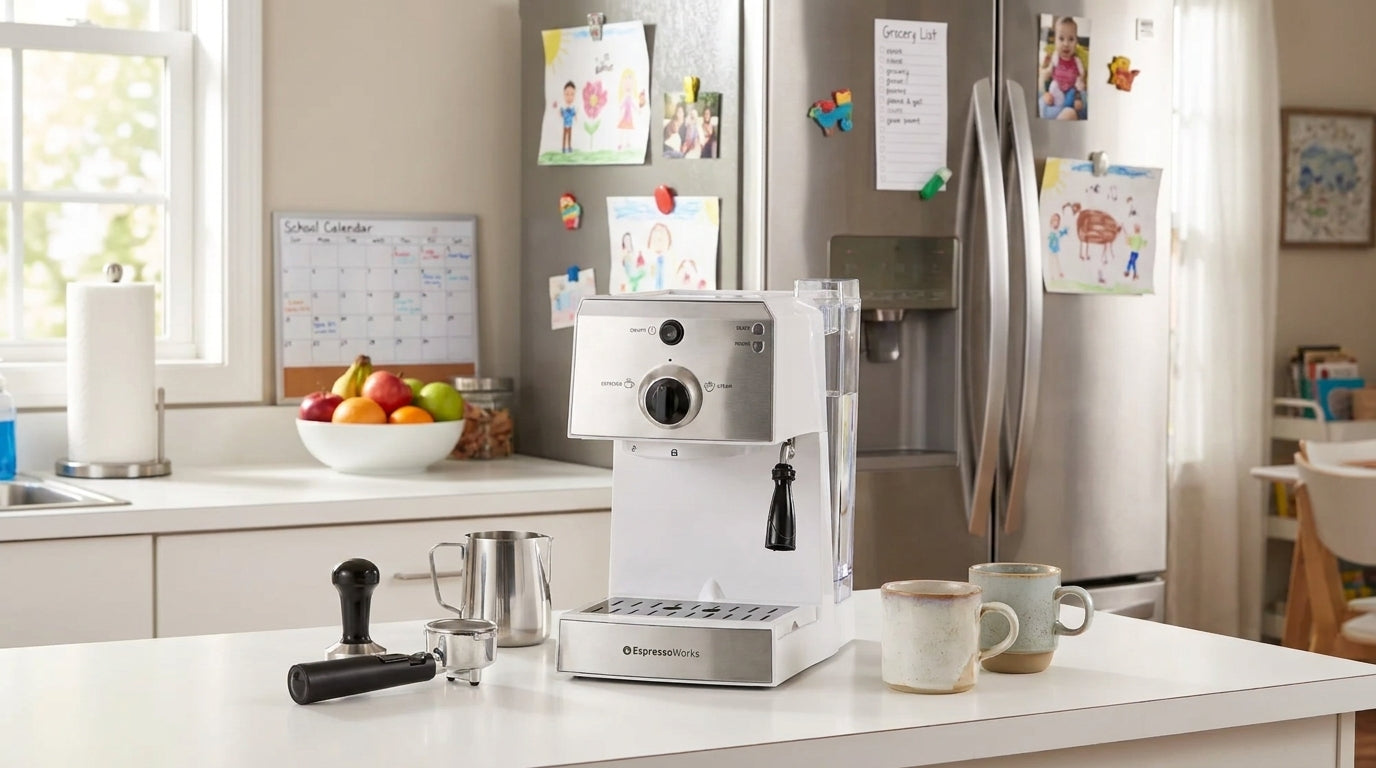
The 15-bar pump extracts full-bodied espresso with proper crema on every shot. The Advanced Thermoblock heats to brew temperature in 45 seconds from cold. The built-in steam wand froths and textures milk for lattes, cappuccinos, flat whites, and hot chocolate. Bean to cup in under a minute.
What's in the box: espresso machine, electric coffee grinder, stainless steel portafilter with single and double shot baskets, milk frothing pitcher, two ceramic cups, and a measuring spoon/tamper. That's the complete setup. No separate grinder purchase, no hunting for a compatible tamper, no third-party pitcher that may or may not fit.
To put the value in context: a comparable standalone 15-bar machine without accessories runs $150-180 in this bracket. Add a grinder ($100+), a tamper ($15-25), a pitcher ($15-20), and cups ($10-15), and you're past $300 for the same functionality the 7-Piece delivers at $199.99.
Four colour options - Stainless Steel, White, Red, and Blue. Rated 4.8 out of 5.0 on-site.
Right for: first-time espresso buyers, anyone replacing a pod machine, households where one person makes 1-2 drinks each morning.
The EspressoWorks 10-Piece Set - More Power, Seven Colour Options
The 10-Piece Set at $229.99 keeps the same all-in-one bundle approach and steps up three things: pump pressure, water tank capacity, and colour range.
The 19-bar pump pulls with more extraction force than the 7-Piece's 15-bar. In the cup, that means a bolder, more concentrated shot and a denser crema. The difference is most noticeable in milk-based drinks - a stronger espresso base comes through more clearly in a full latte or flat white rather than getting lost in the milk.
The 1.4L removable water tank has a built-in handle, which makes filling and reattaching faster when you're making multiple drinks in sequence. At 1250W, the machine handles back-to-back brewing without temperature drop. One-button brewing means the process is: grind, load, press.
Seven colour options make the 10-Piece the most flexible machine in our lineup: Stainless Steel, White, Black, Blue, Red, Green, and Rose Gold. If the 7-Piece's four colours don't fit your kitchen, this is where to look.
Rated 5.0 out of 5.0 on-site. Same 1-year manufacturer warranty and free shipping over $50.
Right for: households making multiple drinks each morning, anyone who wants a more assertive extraction from the start, kitchens where the machine colour matters.
Why a Complete Bundle Beats Buying the Machine Alone
The math is straightforward. A standalone 15-bar espresso machine in the sub-$300 bracket typically runs $150-250. Here's what you still need after buying it:
- Electric grinder: $100-200 for one that grinds fine and consistent enough for espresso. Blade grinders won't cut it.
- Tamper: $15-25 for one that fits your portafilter diameter.
- Frothing pitcher: $15-20 for stainless steel in the right size.
- Espresso cups: $10-15 for a decent pair.
Total for the separate route: $290-510, depending on the machine and grinder. And you've done the compatibility research yourself - making sure the tamper fits the basket, the grinder produces a fine enough grind, and the pitcher works with the wand.
The 7-Piece Set covers all of that at $199.99. The 10-Piece at $229.99. Every piece calibrated to work together. One box, one purchase, one tracking number.
The time-to-first-cup advantage matters too. Open the box, follow the setup guide, and you're pulling shots the same day. No waiting for a separate grinder delivery. No returns because the tamper was the wrong diameter.
Frequently Asked Questions
Is a $200 espresso machine actually good?
Yes - with the right setup. The 7-Piece Set at $199.99 runs a 15-bar pump (the commercial café standard), heats in 45 seconds, and includes a steam wand for milk drinks. The espresso it produces has full body and proper crema. What makes the difference at this price is whether a grinder is included - without one, you're brewing with pre-ground coffee and leaving most of the flavour on the table.
Do I need to buy a grinder separately?
Not with EspressoWorks. Both the 7-Piece and 10-Piece include an electric grinder. Most competing machines in this bracket don't, which is why their "budget" price can double by the time you've added everything you actually need.
What's the difference between the 7-Piece and the 10-Piece?
Four things: the 10-Piece steps up to 19-bar pump pressure (vs 15-bar), a 1.4L removable water tank with handle (vs unspecified on the 7-Piece), one-button brewing, and seven colour options vs four. At $229.99 vs $199.99, it's $30 more for a meaningfully more powerful machine with more flexibility.
Should I spend more and get a $500 machine instead?
Depends on what you need. A $500+ machine typically adds PID temperature control and sometimes a dual boiler for simultaneous brewing and steaming. Both are useful if you're pulling competition-level shots or making 5+ drinks back to back. For 1-3 drinks a morning, neither is a practical limitation at the $200-300 level. The money you save buys a lot of good coffee beans.
What about the 30-Piece Barista Pro?
The 30-Piece Barista Pro at $449.99 is our most comprehensive set - built-in conical burr grinder (integrated into the machine, not separate), digital LCD display, and the largest accessory bundle we make. It sits above the $300 bracket this guide covers, but it's worth knowing about if you want the full barista setup from day one.
---
Which Machine Is Right for You

Two machines, two price points, both under $300, both complete.
Start with the 7-Piece at $199.99 if you're buying your first espresso machine, upgrading from pods, or want the simplest path from box to first shot. 15-bar pump, 45-second heat-up, everything included.
Step up to the 10-Piece at $229.99 if you want 19-bar pressure, a 1.4L removable tank, one-button brewing, or a colour to match your kitchen - including Black and Rose Gold.
Both come with a 1-year manufacturer warranty and free shipping on orders over $50. No additional purchases required. No compatibility research. Pick your set, open the box, and pull your first shot. You'll taste the difference.